You must be signed in to read the rest of this article.
Registration on CDEWorld is free. Sign up today!
Forgot your password? Click Here!
In general dentistry, preventative and restorative care is usually the primary goal of a practice; however, prevention with protective mouthguards and treatment of orofacial trauma should also be a goal.1,2 Incorporating these into the practice would require a team effort involving the office staff, dental assistants, hygienists, and dentists. Dentistry has increasingly been recognized by various medical organizations such as the International Olympic Committee's Medical Commission and the International Ice Hockey Federation Medical Commission as an important component and partner in treating patients with orofacial injuries,3 which has increased the awareness and importance of sports dentistry. It is the role of a dental team to help educate patients, parents, coaches, trainers, and officials on the importance of having a dentist on the team for the prevention and treatment of orofacial injuries. One approach for the dental team is to establish a mouthguard program in their community to help the local teams.4 Athletic teams ideally should have a team dentist or at least have one available on-call to help with injured players.5
This article will review reasons athletes prefer not to wear mouth-guards and advantages of a custom-made mouthguard, as well as describe a process to fabricate a custom-made mouthguard.
Today, children and adults participate in activities where trauma to the orofacial regions may occur at any time, from a pickup basketball game to organized professional sports. With an increase in sporting activities comes an increase in orofacial injuries.6 According to The National Youth Sports Safety Foundation, there are about 15 million dental injuries and 5 million avulsed teeth,7 with 13% to 39% of those injuries related to sporting activities in the United States annually.8
A properly fitted mouthguard has been shown to provide protection against orofacial injuries and trauma to the teeth and supporting tissues such as the lips, cheeks, and tongue.9 Mouthguards can also provide protection to the mandible, temporomandibular joint, neck, and also prevent concussions.8,10-13 Any orofacial injury has a potential component of injury to the head and considerations must be given for a possible concussion.5 An effective strategy to increase the use of mouthguards among athletes is to inform the players of these benefits: the possible reduction of injuries and concussion reduces their time on the disabled list and ensures more playing time.14
However, there are only a few amateur sports such as football, boxing, ice hockey, men's lacrosse, and women's field hockey that require the use of mouthguards.5,10,14,15 Boxing is the only professional sport that requires the use of mouthgaurds.5,10,12 In nonmandated sports, only 4% to 6% of the athletes wear a mouthguard.14,16-18 There are even different outlooks with respect to gender in sports. There is a perception that women athletes are less aggressive and have a reduced risk of injury. However, injury rates for women athletes are similar to men, and their need for protection is just as valid.14
There are many reasons athletes do not like to wear a mouthguard, specifically difficulty with breathing14,19,20 and speaking.14 Other cited reasons include the stigma an athlete may have when wearing a mouthguard, fit, and the feel and thickness of the material.14,21 Athletes prefer mouthguards to be comfortable, soft, and resilient,14 which is characteristic of a custom-fitted mouthguard.
Special considerations are needed for mouthguards for young athletes and athletes with fixed orthodontic appliances. Young athletes with mixed dentition are a challenge, and compensation for tooth eruption and growth must be incorporated into the design of the mouthguard. This is accomplished by incorporating spaces for tooth movement and growth of the arches.22 Some have even suggested an external mouthguard for athletes with mixed dentition to avoid affecting the position of teeth, specifically the maxillary incisors.13 Close monitoring of these young athletes is a must, and long-term use of the mouthguard is not recommended because of the constant changes in these individuals.
As for the orthodontic athlete, the bonded brackets are an issue with impression taking. One approach is to block out the brackets with utility wax before the impression stage, which decreases the amount of tear in the impression material.22 Another technique is to block out the brackets on the stone model with another mix of dental stone before fabrication of the mouthguard.10
The American Society for Testing and Materials (ASTM) set the standard for protective equipment, which greatly helped reduce the amount of orofacial injuries.23 ASTM also designated the 3 categories of mouthguards10,13,24 that we use today. They include:
- Type I (stock)
- Type II (mouth-formed)
- Type III (custom-fabricated)
Type I mouthguards are the least expensive of the 3 types and offer the least amount of protection. These mouthguards can be purchased at sporting good stores. The mouthguard is removed from the package and worn with no fitting. An athlete wearing this type of mouthguard is most likely to experience difficulties in breathing, speaking, and gagging because of the bulkiness of the material.14 These mouthguards are the least retentive.
Type II mouthguards are commonly known as the "boil and bite" mouthguards. These are also store bought and are the most popular. The mouthguard is boiled in water and some attempts are made to fit them. Usually, there is an uneven distribution of material, resulting in instability. For example, the mouthguard may be too thick at the periphery or too thin over the occlusal surfaces. These mouthguards also tend to have bite-through issues and over time there is a lack of structural integrity.10 Protection is minimal with this type of mouthguard, but it is slightly better than wearing no mouthguard.
Type III mouthguards are custom-made and are considered the best when compared with the others.5,25-28 They can be made by using a vacuum or a pressure machine. These mouthguards are considered more protective because of the close adaptation of the mouthguard to the athlete's dentition and intra-oral anatomical features. There is also better control in the overall outcome with respect to the thickness of the material on the occlusal table because of the laboratory process.10 It also should be noted that a custom-fitted mouthguard does not need a strap attachment. This is actually contraindicated because of its superior fit.10 Type III mouthguards have better fit, protection, ease of breathing and speaking, acceptance, and adherence when compared with type I and II mouthguards.
Mouthguards can be designed for the type of sport being played. The preferred material of choice for the mouthguard is ethylene vinyl acetate with a shore hardness of 80.3 ASTM also suggests fabricating a mouthguard to fit over 1 arch covering all teeth, using the maxillary arch for class I and II malocclusion and the mandibular arch for class III malocclusion.10,24 When fabricating a mouthguard, the following criteria are suggested to ensure it will be protective29:
- Minimal labial thickness: 3 mm
- Minimal palatal thickness: 2 mm
- Minimal occlusal thickness: 3 mm
- Extensions into the vestibular borders
When fabricating a custom-made mouthguard, there are 4 stages to the fabrication:
- Impression and model
- Fabrication
- Trimming
- Delivery
Impression and Model
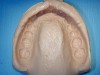
For the impression, it is important to capture all of the anatomical features of the patient, especially the vestibular regions (Figure 1). A poor impression will deliver a poor mouthguard. Alginate with a stock tray is permissible, but when the case is needed, a custom tray with a polyvinyl material is better.
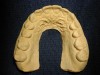
Microstone golden ADA type III, Whip Mix Corporation, is used for pouring up the cast. When pouring up the impression, care must be taken to capture all of the vestibular regions. A base is not necessary. After the cast has hardened, it will be trimmed carefully to the vestibular borders. It is important to maintain the vestibular borders to allow for the mouthguard design to extend into these areas, increasing surface adaptation, which increases retention and protection of the alveolar bone.30 The model also should be trimmed to remove the palatal area (Figure 2). This will ensure proper adaptation of the mouthguard material during the fabrication stage. A final grooming of the cast is next to remove any bubbles.
Fabrication
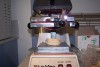
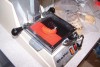
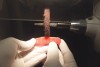
The cast is allowed to dry. Once dry, it is ready for the fabrication of the mouthguard. A laminated mouthguard from Proform Dental Resources, is used in this case. The cast is placed on the vacuum machine, Buffalo Dental, and the mouthguard is heated until the material droops about 1 inch (Figure 3). At this point, the suck-down vacuum is turned on for 1 minute to ensure proper adaptation of the mouthguard over the cast (Figure 4). Some clinicians will advocate using a wet paper towel at this point to help form the mouthguard over the cast. The cast with mouthguard is removed from the vacuum machine and allowed to cool.
Trimming
When the mouthguard has cooled, it is trimmed with a pair of heavy trimming utility scissors or a pair of crown-and-bridge scissors. The mouthguard should be trimmed to follow the vestibular border and locations of the frenum attachments. Lingually, the mouthguard should extend minimally 1 mm from the teeth, and the distal extension should cover up to the first molar.3
The margins of the mouthguard should be feathered for comfort. This is accomplished by using a finishing wheel on a lathe (Figure 5). The mouthguard is placed back onto the cast, and an alcohol torch is used to flame the margins lightly for a final finish.
Delivery
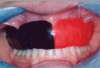
The mouthguard should be fitted on the patient. A try-in is needed to check for fit, retention, and comfort. The frenum attachment locations should be checked to ensure there is freedom of movement. The margins of the mouthguard should extend into the vestibular region (Figure 6). Any adjustments needed should be completed at this time and refinished.
The final step is to lightly warm up the posterior occlusal region of the mouthguard with an alcohol torch. Then it should be placed back in the patient's mouth, and he or she should lightly bite into the mouthguard until the teeth are in occlusion. A dentist does not want the patient to bite so hard as to penetrate the mouthguard or to reduce the minimal thickness of the material to less than 3 mm.
After delivery of the mouthguard, instructions for care should include the following:
1. Before using the mouthguard, it should be rinsed with water.
2. The mouthguard should be washed with cold or lukewarm water after every use to remove saliva buildup, bacteria, debris, and to minimize discoloration.
3. Hot water should not be used because of possible distortion of the mouthguard.
4. The use of toothpaste on a soft-bristle toothbrush and rinses with a mouthwash are permissible.
5. The mouthguard should be stored in a protective plastic appliance container.
6. Periodic check of the mouthguard is recommended. This is to ensure there are no distortions, tears, or bite-throughs.10
If these instructions are followed, the mouthguard should be usable for at least 2 seasons,11 after that, it is highly recommended that a new mouthguard be fabricated.
Conclusion
As the medical community is embracing dentistry in its role of preventing orofacial injuries, the dentist and his or her team must play a key role. Patients, parents, coaches, trainers, and officials should be educated on the importance of having a dentist on the team for the prevention and treatment of orofacial injuries.
Mouthguards are important in preventing orofacial injuries. Fabrication of the mouthguard is easy and requires minimal materials. Time and commitment are needed to help those who participate in sports protect themselves. After all, a dental injury could lead to a lifetime of dental problems.
Disclosure
The author has no financial ties with any of the manufacturers listed in this article.
References
1. Padilla RR, Dorney B, Balikov S. Prevention of oral injuries. J Calif Dent Assoc. 1996; 24:30-36.
2. Padilla RR. Sports in daily practice. J Am Dent Assoc. 1996; 127:815-817.
3. Padilla RR. A technique for fabricating modern athletic mouthguards. J Calif Dent Assoc. 2005; 33:399-408.
4. Kumamoto DP, Winters JE. Private practice and community activities in sports dentistry.Dent Clin North Am. 2000; 44:209-220.
5. Ranalli DN, Demas PN. Orofacial injuries from sport: preventive measures for sports medicine. Sports Med. 2002; 32: 409-418.
6. Guyette RF. Facial injuries in basketball players. Clin Sports Med. 1993; 12:247-264.
7. Fact Sheet. Needham MA: National Youth Sports Safety Foundation;1994.
8. Woodmansey KF. Athletic mouth guards prevent orofacial injuries: a review. Gen Dent. 1999; 47:64-69.
9. Mekayarajjananonth T, Winkler S, Wongthai P. Improved mouth guard design for protection and comfort. J Prosthet Dent. 1999; 82: 627-630.
10. Ranalli DN. Prevention of sports-related traumatic dental injuries. Dent Clin North Am. 2000; 44:35-51.
11. Lee-Knight CT, Bell RD, Faulkner RA, et al. Protective mouthguards and sports injuries. J Can Dent Assoc. 1991; 57: 39-41.
12. Stenger JM, Lawson EA, Wright JM, et al. Mouthguards: protection against shock to head, neck and teeth. J Am Dent Assoc. 1964; 69:273-281.
13. Castaldi CL. Dentistry for the Adolescent. Philadelphia, PA: WB Sanders, Co; 1980:233-241.
14. Gardiner DM, Ranalli DN. Attitudinal factors influencing mouthguard utilization. Dent Clin North Am. 2000; 44:53-56.
15. Kumamoto D, Maeda Y. Are mouthguards necessary for basketball? J Calif Dent Assoc. 2005; 33:463-470.
16. Kvittem B, Hardie NA, Roettger M, et al. Incidence of orofacial injuries in high school sports. J Public Health Dent. 1998; 58:288-293.
17. Rodd HD, Chesham DJ. Sports-related oral injury and mouthguard use among Sheffield school children. Community Dent Health. 1997; 14: 25-30.
18. Maestrello-deMoya MG, Primosch RE. Orofacial trauma and mouth-protector wear among high school varsity basketball players. ASDC J Dent Child. 1989; 56:36-39.
19. Francis KT, Brasher J. Physiological effects of wearing mouthguards. Br J Sports Med. 1991;25:227-231.
20. Schwartz R, Collins BJ, Fong C. Effects of a single and double commercial athletic mouthpiece on expiratory peak flow: a pilot study. Cranio. 2000;18:23-29.
21. Kenyon BJ, Loos LG. Comparing comfort and wearability between type III single-layered and doubled-layered EVA mouthguards. Gen Dent. 2005;53:261-264.
22. Croll TP, Castaldi CR. Custom sports mouthguard modified for orthodontic patients and children in the transitional dentition. Pediatr Dent. 2004; 26:417-420.
23. Castaldi CR. Sports-related oral and facial injuries in the young athlete: a new challenge for the pediatric dentist. Pediatr Dent. 1986; 8:311-316.
24. American Society for Testing and Materials: Standard Practice for Care and Use of Mouthguards. Designation: F 697-80. Philadelphia, PA: American Society for Testing and Materials. 1986:323.
25. Guevara PA, Ranalli DN. Techniques for mouthguard fabrication. Dent Clin North Am. 1991; 35:667-682.
26. DeYoung AK, Robinson E, Godwin WC. Comparing comfort and wearability: custom-made vs. self-adapted mouthguards. J Am Dent Assoc. 1994; 125:1112-1118.
27. Scott J, Burke FJ, Watts DC. A review of dental injuries and the use of mouthguards in contact team sports. Br Dent J. 1994; 176: 310-314.
28. Bemelmanns P, Pfeiffer P. Shock absorption capacities of mouthguards in different types and thicknesses. Int J Sports Med. 2001;22:149-153.
29. Hunter K. Modern mouthguards. Dental Outlook. 1989; 15:63-67.
30. Padilla RR, Felsenfeld AL. Treatment and prevention of alveolar fractures and related injuries. J Craniomaxillofac Trauma. 1997; 3:22-27.