

CDEWorld > eBooks > Novel Strategies in Digital Dentistry

ADA CERP is a service of the American Dental Association to assist dental professionals in identifying quality providers of continuing dental education. ADA CERP does not approve or endorse individual courses or instructors, nor does it imply acceptance of credit house by boards of dentistry. Concerns or complaints about a CE provider may be directed to the provider or to ADA CERP at www.ada.org/cerp/
Approved PACE Program Provider. FAGD/MAGD credit. Approval does not imply acceptance by a state or provincial board of dentistry, or AGD endorsement. 1/1/2023 to 12/31/2028. ID # 209722.
eBook
Released: Thursday, January 22, 2026
Expires: Saturday, July 31, 2027
Novel Strategies in Digital Dentistry
Commercial Supporter: Dandy
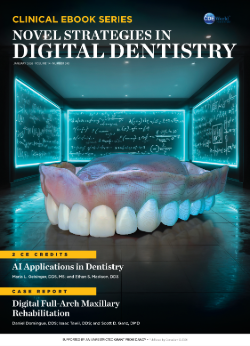
This thematic CDEWorld eBook on digital dentistry features a continuing education (CE) article on artificial intelligence (AI) and its applications in dentistry. A case report article describing a digital approach to full-arch maxillary rehabilitation for implant cases is also included in this eBook.
FEATURED CONTENT
CE: AI Applications in Dentistry
Maria L. Geisinger, DDS, MS; and Ethan S. Madison, DDS
This continuing education article examines how an understanding of AI algorithms informs the responsible use of AI-powered dental technologies. The lack of professional and academic discussion surrounding the ethical use of AI in dentistry is discussed, including questions regarding whether patients can give true informed consent to its use, given the opacity of the AI algorithms. Clinical risks are also examined, such as those that may be introduced by unclear or unintelligible algorithms. Finally, the various applications of AI in dentistry are summarized, along with guidance regarding benefits and challenges.
Credits: 2 Self-Study CEU
Cost: $0
Provider: Conexiant Education
Digital Full-Arch Maxillary Rehabilitation
Isaac Tawil, DDS, MS; Daniel Domingue, DDS; and Scott D. Ganz, DMD
This case report article describes the treatment of a patient requiring full-arch maxillary rehabilitation involving implant-supported restorations. The use of digital intraoral and facial scanning for this case is discussed, as well as the delivery of a 3D printed provisional solution by accurately capturing the postsurgical implant position digitally and relating it to the preoperative plan, which expedites conversion and printing.
